Best Beaches in Africa

Introduction
A continent this large doesn’t have a single coastline — it has dozens, shaped by different oceans, currents, and histories. The Indian Ocean side, warmed by equatorial currents, produces the calm, reef-protected lagoons that fill glossy brochures: Zanzibar, the Seychelles, Mauritius. The Atlantic side is a different animal entirely — colder water pushed up from the Southern Ocean, and along West Africa, the long, unbroken swells that have turned towns like Busua in Ghana into surf destinations almost by accident. Between them sits the Cape Peninsula, where two oceans meet and penguins share the sand with sunbathers.
What follows isn’t a ranked list. Ranking beaches is a fool’s errand — the “best” beach for a honeymoon kitesurfer chasing wind in Le Morne has nothing to do with the “best” beach for someone who wants to understand the Atlantic slave trade before they ever put a towel down. Instead, this is a working guide to eight stretches of African coast that each do something the others don’t, chosen for variety of experience as much as beauty. Some are famous. A few deserve to be more famous than they are.
Diani Beach, Kenya
Diani sits on Kenya’s south coast, in Kwale County, roughly half an hour by air or a couple of hours by road from Mombasa. It has picked up a string of industry awards over the years, including recognition from the World Travel Awards as one of Africa’s leading beach destinations — though readers planning a trip around a specific title should check the current year’s winners, since these awards are handed out annually and the list shifts. What doesn’t shift is the geography: a coral reef runs parallel to the shore for most of Diani’s roughly seventeen kilometers, breaking the Indian Ocean’s swell before it reaches the sand and creating a lagoon calm enough for children to swim in at almost any tide.
The coral origin of the sand matters practically — it stays notably cool underfoot even at midday, unlike the silica sand found on many Atlantic beaches. Offshore, the reef and the deeper Kisite-Mpunguti Marine Park to the south hold healthy populations of green and hawksbill turtles, and whale sharks pass through between roughly November and February, drawing divers who’d otherwise have to travel to Mozambique or the Philippines for a comparable encounter. Diani is also East Africa’s most established kitesurfing hub, thanks to reliable trade winds; the Kenya Kite Cup runs here most Januarys.
What sets Diani apart from other Indian Ocean beach towns is what sits behind it. Shimba Hills National Reserve, a short drive inland, is the only place in Kenya to see sable antelope in the wild, and its patch of coastal rainforest supports a healthy colobus monkey population — a genuinely different ecosystem from the savanna most visitors have just left behind on safari. That’s the appeal for a lot of travelers: Diani has become the default coastal finish to a Kenyan safari, a half-day transfer from the Maasai Mara or Amboseli that trades dust for salt air. The dry season, June to October, brings the clearest water and least humidity; a second, warmer dry spell runs from around December into February.
Zanzibar’s North Coast—Nungwi, Kendwa, and the Wind Coast at Paje
Zanzibar is not one beach but several, and the difference between them comes down almost entirely to tide. On the island’s northern tip, Nungwi and Kendwa face open water and lose relatively little sand as the tide goes out — you can swim more or less all day. A twenty-minute walk apart, they’ve developed slightly different personalities: Nungwi is livelier, with dhow-building traditions still visible on the beach and a busier evening scene; Kendwa is quieter and hosts the well-known Full Moon parties at Kendwa Rocks, alongside a run of upscale resorts favored by honeymooners.
Head to the east coast, around Paje and Jambiani, and the picture changes completely. Here the tide can pull back over a kilometer, exposing reef flats and the seaweed farms that have supported local women’s cooperatives for decades — not litter or neglect, but a working part of the coastal economy that happens to reshape the view twice a day. What the east coast loses in swimmable hours, it gains in wind: Paje has become East Africa’s kitesurfing capital, drawing riders for the same reliable monsoon patterns — locally the Kaskazi and Kusi winds — that have shaped Zanzibari sailing for centuries.
None of this happens in a vacuum. Zanzibar’s identity was built on the spice and clove trade and centuries of Swahili, Omani, and Persian exchange across the Indian Ocean, a history still visible in Stone Town’s carved doors and coral-stone architecture, a short transfer from any of the north coast beaches. Divers based around Matemwe, on the northeast coast, use it as a jumping-off point for Mnemba Atoll, one of the better reef sites in the region. The most reliable months are June to October and December to March; the long rains fall in April and May.
Bazaruto Archipelago, Mozambique
Bazaruto asks more of a traveler than Zanzibar or Diani — there’s no direct international flight, and most visitors connect through Vilanculos on the Mozambican mainland before a boat or helicopter transfer — and that extra effort has kept it comparatively undeveloped. Five islands make up the group, protected as one of the oldest marine national parks in the region, and their signature feature isn’t the beach itself so much as what rises behind it: dune systems tall enough to sandboard down, cresting over turquoise water on the other side.
The archipelago holds the last known viable population of dugongs in the western Indian Ocean, alongside nesting turtles, manta rays, and a resident and migratory whale population that passes through roughly July to September. Two Mile Reef, the main dive site, regularly turns up reef sharks and dense coral gardens in visibility that can reach thirty meters in the clearer months. None of it feels staged. Sailing here still happens by dhow, not because it’s a tourist activity dressed up as tradition, but because it’s genuinely how people have moved along this coast for generations — most lodges simply built an excursion around something that was already happening.
Accommodation skews toward the luxury end — properties like Anantara Bazaruto Island Resort, &Beyond Benguerra Island, and Kisawa Sanctuary anchor the archipelago’s reputation, though smaller eco-lodges exist for travelers willing to trade some polish for a lower price. Bazaruto works particularly well tacked onto a Southern African safari circuit — Kruger, Gorongosa, or a Zimbabwe or Zambia itinerary — as a way to end a trip with several unhurried days by water instead of one more game drive.
Boulders Beach and the Cape Peninsula, South Africa
Cape Town’s beaches are really a study in contrasts along one stretch of coastline. Camps Bay and Clifton, on the Atlantic side, deliver the postcard shot — white sand under Table Mountain’s Twelve Apostles ridge — but the water is genuinely cold, fed by the Benguela Current sweeping up from the Southern Ocean, so it’s a beach for sundowners and sunbathing more than long swims. Around the peninsula on the False Bay side, roughly forty minutes to an hour from the city center near Simon’s Town, Boulders Beach offers something no other beach in Africa can: a resident colony of African penguins living among wind-sheltering granite boulders, close enough to watch from a boardwalk without disturbing them.
The colony’s story is worth knowing before you go, because it changes how the visit lands. A pair of penguins settled at Boulders in the early 1980s, drawn by a fishing closure in False Bay that left more food in the water, and the population grew from that handful of birds into several thousand. It’s a genuine conservation success story — except that the species as a whole is not doing well at all. In 2024, the International Union for Conservation of Nature uplisted the African penguin from endangered to critically endangered, the first of the world’s eighteen penguin species to reach that classification; the wild population has fallen by roughly 97 percent from historic levels, driven mainly by commercial fishing competition for the sardines and anchovies penguins depend on, and researchers have warned the species could disappear from the wild within the next decade absent stronger intervention. Seeing them at Boulders is not simply a photo opportunity — tourism revenue from the colony has become one of the arguments conservationists use for stronger protection, which makes a respectful, informed visit more meaningful than it might otherwise be.
The wider Cape Peninsula rewards a full day: Chapman’s Peak Drive between Hout Bay and Noordhoek is one of the most scenic coastal roads on the continent, and Muizenberg, with its row of brightly painted beach huts, is where most of Cape Town learns to surf.
Le Morne, Mauritius
Le Morne sits at the southwestern tip of Mauritius, beneath the basalt peak of Le Morne Brabant — a mountain that carries real historical weight. During the era of slavery on the island, the mountain’s caves and cliffs served as a refuge for escaped slaves, known as maroons, and UNESCO inscribed the Le Morne Cultural Landscape as a World Heritage Site in recognition of that history, not simply for the scenery. It’s a detail worth sitting with before diving into the lagoon in front of it.
The beach itself splits into two moods depending on which side you’re standing on. West of the mountain, the water is sheltered and shallow for a long way out — good for families, floating, and the kind of unhurried swim that doesn’t require much skill. Round to the south side, consistent trade winds turn the same stretch of coast into one of the world’s recognized kitesurfing and windsurfing spots, anchored by a wave break known as One Eye that draws experienced riders from well beyond the island. Mauritius overall carries a similarly layered identity to its coastline — Dutch, French, and British colonial rule in succession, followed by waves of indentured labor from India that make the island’s population today a genuine blend of African, Indian, Chinese, and European heritage, visible in everything from the food to the Creole language spoken alongside English and French. The dry season, roughly May through December, is the more reliable window for calm seas and consistent wind for water sports.
Anse Source d’Argent, La Digue, Seychelles
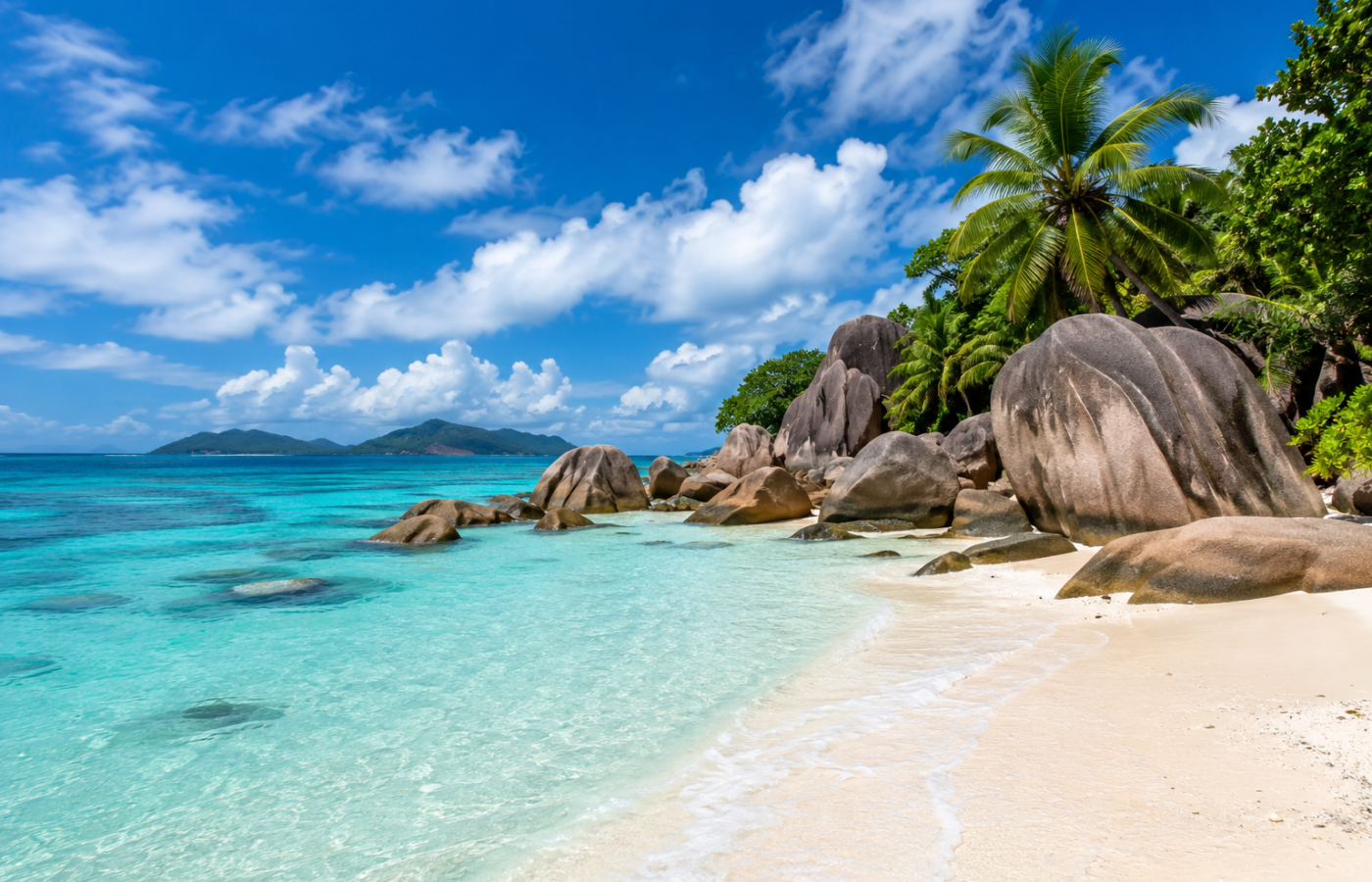
Of everything on this list, Anse Source d’Argent is the beach travelers have probably already seen, even if they don’t recognize the name — it shows up constantly in stock photography and honeymoon marketing, largely because of a geological quirk unique to the Seychelles. Unlike most tropical islands, which are volcanic or built from coral, several of the Seychelles’ inner islands, including La Digue, are granite — remnants of ancient continental crust rather than newer volcanic rock. That’s what produces the huge, smoothly weathered boulders scattered along the shoreline here, sculpted by millions of years of erosion into shapes that look almost deliberately arranged.
Getting to the beach means passing through L’Union Estate, a former coconut and vanilla plantation that charges a modest entrance fee — worth the short detour for the plantation buildings alone, a quieter piece of Seychellois history than the beach that follows. The water stays shallow and calm for a long stretch, sheltered enough for confident swimming and snorkeling, though the sand does narrow noticeably at high tide, and the beach draws enough day-trippers that arriving early morning or staying into late afternoon makes a real difference. La Digue itself gets around by bicycle rather than car, which keeps the pace of the island slow in a way that suits the beach’s reputation. Nearby, Grand Anse and the more secluded Anse Marron — reachable only with a guide, across rock and tide pools — offer variations on the same granite-and-sand formula for travelers willing to walk a little further.
Santa Maria and Kite Beach, Sal, Cape Verde
Cape Verde sits in the Atlantic roughly off the coast of Senegal, and it feels closer to a mid-Atlantic outpost than to the rest of the African mainland — a former Portuguese colony whose population and culture reflect centuries of trans-Atlantic exchange, including a musical tradition, morna, that UNESCO has recognized as intangible cultural heritage. On the island of Sal, the town of Santa Maria anchors a long, straightforward beach good for swimming and beginner watersports, but the real draw for a specific kind of traveler lies just east: Kite Beach, a roughly three-kilometer stretch dedicated almost entirely to kitesurfing.
The wind here is close to guaranteed — steady northeast trade winds, locally called the Alisios, blow at 15 to 25 knots for much of the year, with the most reliable window running from around October through May. Kite Beach itself sits within a protected nature reserve that shelters nesting loggerhead turtles, an odd but workable coexistence between an adrenaline sport and a conservation area. More advanced riders make a pilgrimage a short distance further to Ponta Preta, a wave break that has hosted stops on the Kite World Tour and is watched, if not ridden, by most visitors who make it that far. Sal isn’t a beach for travelers chasing untouched wilderness — it’s built around a specific, well-organized watersports economy — but for wind sports, it’s one of the most consistent coastlines on the continent.
Busua Beach and Cape Coast, Ghana
Ghana’s coastline offers something the Indian Ocean side of the continent generally doesn’t: real Atlantic surf, and a far more layered, often difficult history sitting directly on the sand. Busua, a small fishing town in the Western Region, has become the country’s de facto surf capital — a sand-bottomed beach with waves gentled just enough by rocks to the west that it works well for beginners, alongside a handful of surf camps, some of which double as community projects supporting local kids with boards and lessons. Ghana’s surf season runs roughly April through September, powered by long-fetch swells traveling up from storms in the South Atlantic, the same weather systems that generate waves further south in Namibia.
An hour or two east, Cape Coast and Elmina hold some of the most significant and sobering historical sites on the continent: Cape Coast Castle and Elmina Castle, both UNESCO World Heritage Sites, were central points in the transatlantic slave trade, and their dungeons remain open to visitors as a deliberately unflinching memorial rather than a sanitized attraction. Pairing a day at these castles with an afternoon on a Ghanaian beach isn’t an odd juxtaposition — it’s arguably the most honest way to experience this coastline, since the beauty and the history sit within a few kilometers of each other and always have. Kokrobite, closer to Accra, offers a livelier, backpacker-friendly alternative for travelers who want music and dancing alongside the water, while Keta, further east, is known for kitesurfing and long, quieter sand.
Conclusion
Put these eight beaches side by side and what stands out isn’t a shared aesthetic — it’s how little they have in common. A tidal sandbar in Zanzibar has almost nothing to do with a UNESCO-protected mountain lagoon in Mauritius, and a surf town built around slave castles in Ghana sits in a different emotional register entirely from a granite cove in the Seychelles. That range is really the point. Africa’s coastline runs across three oceans and dozens of distinct histories, and treating it as a single “beach destination” flattens exactly what makes it worth visiting. The better approach is to pick a beach for what it actually offers — wind, wildlife, history, reef, or simply rest — rather than for how closely it resembles the last postcard you saw.
Frequently Asked Questions
What is generally considered the best beach in Africa? There’s no single agreed answer, and any credible travel writer should be honest about that. Diani Beach in Kenya has picked up the most industry recognition over the years for its combination of swimmable reef-protected water and accessibility, but Zanzibar’s north coast, Mauritius’s Le Morne, and the Seychelles’ Anse Source d’Argent are cited just as often depending on what a traveler is looking for.
Which African beaches are safe for swimming year-round? Reef-protected beaches with minimal tidal swing tend to be the most reliable, notably Diani in Kenya and the northern Zanzibar beaches around Nungwi and Kendwa. Always check for rip currents, jellyfish seasons, and local advisories, since conditions vary by season even at generally calm beaches.
When is the best time of year to visit East Africa’s Indian Ocean beaches? Most of the region, including Kenya’s coast and Zanzibar, is at its best from June through October and again from December into February, avoiding the long rains that typically fall in April and May. Exact timing shifts slightly year to year, so it’s worth checking closer to travel.
Are Africa’s best beaches good for a post-safari trip? Yes — this is one of the more popular travel patterns on the continent. Diani Beach works as a short transfer from Kenyan safari circuits like the Maasai Mara, and Mozambique’s Bazaruto Archipelago pairs naturally with Southern African safari routes through Kruger or Zimbabwe.
Is it possible to combine history and beach time in West Africa? Ghana’s coast is built for exactly this. Cape Coast and Elmina Castles, both UNESCO World Heritage Sites tied to the transatlantic slave trade, sit within a short drive of beach towns like Busua, making it possible to spend a morning with difficult history and an afternoon in the ocean without much travel between the two.